The Strategic Value of a Modern Business Impact Analysis (BIA)
Posted on 10 December 2025 11:32
In today’s hyper-connected and constantly evolving risk landscape, effective Governance, Risk, and Compliance (GRC) relies on a clear understanding of operational vulnerabilities. The foundational practice for this understanding is the Business Impact Analysis (BIA). As the crucial first step in any robust Business Continuity Management System (BCMS), it is formally required by the global standard, ISO 22301. Often viewed simply as an exercise for BC planning, a well-executed, modern BIA is, in fact, a powerful strategic tool for enhancing organisational resilience and maximising stakeholder value.
The Need for a Holistic View
A common pitfall of traditional BIA methods is their narrow focus, often concentrating solely on direct financial loss. However, a significant disruption triggers a ripple effect that touches every part of the enterprise. True risk assessment requires a holistic, multi-dimensional view that moves beyond simple balance sheet figures. Best practices, such as those advocated by NIST (National Institute of Standards and Technology) guidelines, require assessing impact across multiple dimensions specifically including Reputation, Legal, and Operational factors to ensure systems are protected based on total business criticality.
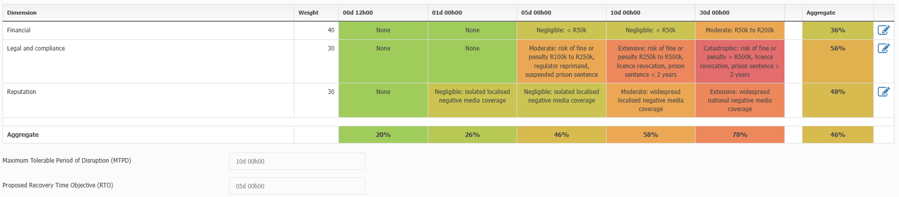
Modern BIA practices, as demonstrated by leading GRC platforms, provide this crucial richer picture. By assessing impact across multiple configurable dimensions such as Financial, Legal and Compliance, and Reputation, organizations gain a comprehensive, weighted view of their exposure. For example, a system failure might have a moderate financial impact, but simultaneously pose a catastrophic risk to compliance due to regulatory reporting breaches, or trigger extensive negative media coverage that erodes market trust for years.
The Power of Time-Based Granularity
A critical element that separates strategic BIAs from mere compliance exercises is the assessment of impact over time. Severity is not static. It grows exponentially the longer a critical process remains disrupted.
A multi-dimensional, time-based matrix allows risk managers to quantify this escalation. For instance, a financial impact that is Negligible at the 5-day mark might surge to Moderate by the 10-day mark. Simultaneously, a legal risk that was initially Moderate could escalate to an Extensive threat involving license revocation or mandated legal action if the disruption continues past a critical threshold. By weighting these factors, an aggregate impact score is calculated at various time intervals, providing an objective, quantifiable measure of mounting risk.
From Analysis to Actionable Strategy
The ultimate business value of the BIA lies in its output: the derivation of essential recovery metrics that dictate resource allocation and strategic planning. The calculated aggregate impact score directly informs three vital metrics as defined by international standards like ISO 22301:
- Maximum Tolerable Period of Disruption (MTPD): This establishes the absolute limit an organisation can endure an outage before the total impact becomes Catastrophic (e.g., 10 days). It is the line that must not be crossed.
- Recovery Time Objective (RTO): This is the targeted time for resuming operations (e.g., 5 days). The RTO is strategically set before the MTPD to ensure a buffer for recovery, testing, and unforeseen complications.
- Recovery Point Objective (RPO): This defines the maximum acceptable age of data loss that an organisation can sustain. It drives the design and frequency of backup and data replication strategies.
By linking RTO and MTPD directly to the multi-dimensional impact score, organisations ensure that recovery efforts are prioritised based on factual, aggregated business criticality, rather than guesswork or historical bias. Processes contributing to a high aggregate score (e.g., those impacting Legal or Reputation most severely) are guaranteed to receive the fastest RTOs and most robust recovery solutions.
Conclusion
Conducting a comprehensive BIA is far more than a task for the Business Continuity team. It is an intelligent component of a sound GRC strategy. By adopting a multi-dimensional, time-based approach, organisations move beyond simple risk identification to proactive resilience engineering. This strategic clarity allows for optimal resource allocation, focused investment in critical process recovery, and the preservation of financial health, legal standing, and invaluable brand reputation. The BIA is the essential compass that guides the enterprise toward sustained operational continuity and strategic success.