The Governance, Risk, and Compliance (GRC) Data Model: Building an Intelligent Compliance Framework
Posted on 06 January 2026 19:59
In today's complex regulatory environment, organisations must navigate a web of policies, processes, risks, controls, and compliance requirements. Developing an effective data model to manage these elements requires understanding their fundamental relationships. This article explains these connections through simple analogies and demonstrates why mapping these relationships transforms compliance from a bureaucratic exercise into strategic intelligence.
The Building Analogy: Understanding the Components
Imagine constructing a secure, code-compliant building:
External Requirements (The Why)
- Legislation, Regulations & Standards = Building Codes and Zoning Laws
External rules the organisation must follow
Internal Response (The What and How)
- Policies = Architectural Blueprints
High-level statements of what the organisation will do to meet requirements - Processes = Step-by-Step Construction Plans
Detailed procedures implementing policies - Risks = Things That Could Go Wrong
Potential failures in processes or compliance gaps - Controls = Safety and Quality Checks
Specific safeguards preventing or detecting risks
The Relationship Chain: How Everything Connects
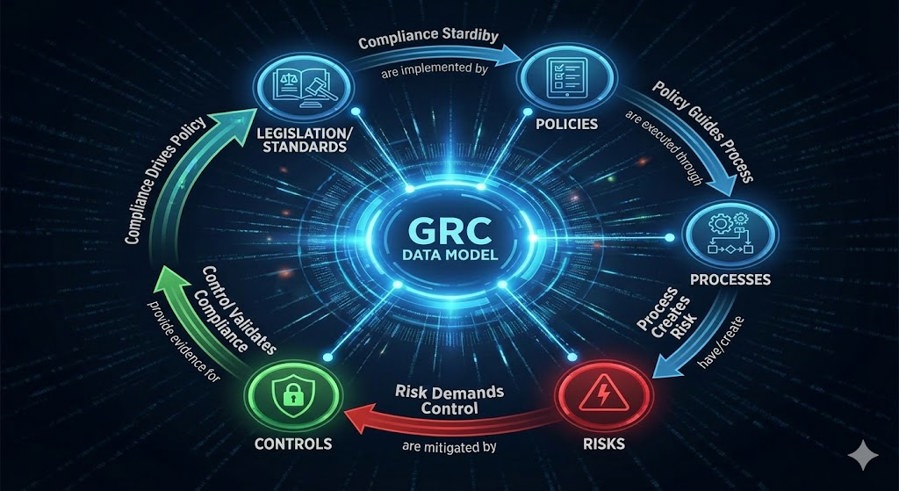
The power of a GRC data model emerges from how these elements interrelate:
- Compliance Drives Policy: Legislation/Standards → are implemented by → Policies
- Policy Guides Process: Policies → are executed through → Processes
- Process Creates Risk: Processes → have/create → Risks
- Risk Demands Control: Risks → are mitigated by → Controls
- Control Validates Compliance: Controls → provide evidence for → Legislation/Standards
Practical Example: Payment Card Security
- Standard: PCI DSS requires cardholder data protection
- Policy: "All stored credit card numbers must be encrypted"
- Process: "Card-on-File" storage in e-commerce system
- Risk: Data breach from unencrypted storage
- Control: Automated encryption software
- Complete Loop: The control (encryption) provides evidence of PCI DSS compliance
Why These Relationships Matter: Five Strategic Benefits
Understanding these relationships transforms disconnected documents into an intelligent management system.
| Benefit | Without relationships | With relationships | Business impact |
| Efficient Compliance Demonstration | Manual document scrambling during audits | Instant traceability from regulation to control | Faster, cheaper audits with demonstrated control mastery |
| Intelligent Impact Analysis | No visibility into how regulatory changes affect operations | Immediate identification of affected policies, processes, and controls | Proactive response to regulatory changes with accurate cost/effort estimates |
| Risk-Based Resource Allocation | Equal treatment of all risks, regardless of importance | Clear visibility into which risks impact critical regulations and processes | Strategic investment in controls that matter most to business continuity and compliance |
| Root Cause Resolution | Symptom-focused responses to control failures | Ability to trace control failures back through risks to processes and policies | Systemic improvements that strengthen entire control environments |
| Operational Efficiency | Redundant controls across departments | Visibility into overlapping controls serving multiple requirements | Consolidated controls that reduce costs while maintaining compliance |
Implementation Framework
To build this intelligent system, structure your data model to capture:
- The Compliance Layer: External requirements with effective dates and jurisdictions
- The Governance Layer: Policies mapped to specific requirements
- The Operational Layer: Processes with risk assessments
- The Control Layer: Preventative/detective controls with testing schedules
- The Evidence Layer: Documentation proving control effectiveness
The Business Transformation
A well-structured GRC data model creates a governance nervous system that provides:
- Strategic Clarity: Understanding what truly matters for compliance and risk management
- Proactive Management: Anticipating problems before they occur
- Cost Efficiency: Eliminating redundant efforts and focusing resources
- Business Enablement: Supporting growth with proper risk oversight
- Stakeholder Confidence: Demonstrating reliable compliance to regulators, investors, and customers
Conclusion
The relationships between legislation, policies, processes, risks, and controls form the backbone of effective organisational governance. By modeling these connections intentionally, organisations transform compliance from a reactive cost center into a proactive strategic asset. This framework doesn't just organise information, it creates organisational intelligence, enabling businesses to navigate complexity with confidence while building resilience, trust, and sustainable value.
Exponuity adopts this framework and provides a ready-to-use capability to catalogue these relationships.