Multi-Dimensional Risk Intelligence is the New Executive Standard
Posted on 15 February 2026 15:13
In the South African boardroom, the language of risk is changing. Gone are the days when a simple "High-Medium-Low" heat map was sufficient to satisfy a Board of Directors or an ISO auditor. As we navigate the complexities of the POPI Act, evolving King IV expectations, and a string of high-profile local data breaches, senior executives are realizing that simplified risk scores often hide more than they reveal.
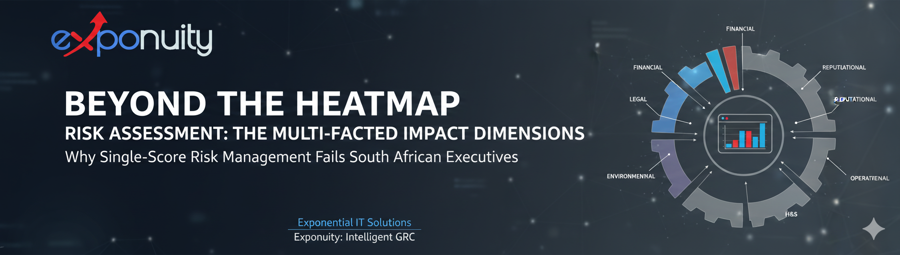
At Exponential IT Solutions, our GRC tool, Exponuity, solves a specific problem: the "Impact Blind Spot." To manage a modern enterprise, you must move beyond mono-dimensional scoring and embrace Multi-Faceted Impact Dimensions.
The Danger of the "Single Score" Fallacy
When a risk is assessed on a single scale, it forces a false equivalence between vastly different consequences. If a cyber-attack is rated as a "Level 4 Impact," does that mean it will cost R10 million, shut down production for a week, or land the Information Officer in legal hot water?
Without granularity, decision-makers cannot prioritise. A risk that is "High" financially but "Low" reputationally requires a different capital allocation than a risk that threatens your "Social License to Operate."
Tailoring Dimensions to ISO Standards
Different ISO certifications require different "lenses" of impact. A truly effective GRC system must pivot its evaluation criteria based on the domain:
- ISO 27001 (Information Security): Evaluates the CIA Triad—Confidentiality, Integrity, and Availability.
- ISO 45001 (Health & Safety): Focuses on the severity of physical harm and long-term occupational health.
- ISO 22301 (Business Continuity): Centers on Recovery Time Objectives (RTO) and service availability.
- ISO 14001 (Environmental): Measures ecological footprint and regulatory compliance.
Defining the Parameters: Moving from Subjective to Objective
The most significant weakness in legacy GRC processes is subjectivity. One manager’s "Moderate" is another’s "Catastrophic." Exponuity eliminates this by allowing executives to configure specific, quantifiable parameters for each dimension.
- The Financial Dimension
Instead of "Major Loss," we define clear Rand-value thresholds.
Exponuity Parameter: Impact > R5,000,000 or > 2% of quarterly EBITDA. - The Legal & Regulatory Dimension
In South Africa, the Information Regulator has increased its enforcement posture, recently issuing multi-million Rand fines to major departments.
Exponuity Parameter: Administrative fine up to R10m per POPIA Section 109, or potential jail time for directors. The Reputational Dimension
Reputation in the age of social media is volatile.
Exponuity Parameter: Sustained negative sentiment on X (Twitter)/LinkedIn; mention in national press for >3 days; loss of more than 5% of the customer base.
The Breakthrough: Dimension-Level Control Application
Perhaps the most powerful feature of Exponuity is the ability to apply controls to specific dimensions rather than the risk as a whole.
Most controls are specialists, not generalists. An insurance policy mitigates financial loss, but it doesn't stop your data from being leaked. A firewall protects confidentiality, but it doesn't help you with a Health and Safety audit.
How Weighted Net Scoring Works
Exponuity calculates a Net Residual Score by assessing how much a specific control reduces a specific dimension:
- Assign Weights: You might decide that for a specific project, Reputational Impact is 60% of your concern, while Financial Impact is only 20%.
- Targeted Mitigation: You map "Control A" (e.g., Encryption) to the Confidentiality dimension. The system calculates a reduction for that dimension only.
- The Result: You get a mathematically defensible residual risk score that reflects the true state of your protection.
Case Study: The "Double-Edged" Breach
Scenario
A large South African financial services provider suffers a breach of 100,000 customer records.
The Traditional View
The risk was marked "High." A "Cyber Policy" was listed as a control. The residual risk was lowered to "Medium." The Board felt safe.
The Exponuity View (Multi-Dimensional)
Exponuity broke the impact down into three dimensions:
- Financial Impact: R8m (Remediation + Fines).
- Legal Impact: Violation of POPIA conditions.
- Reputational Impact: High (Trust is the primary product).
The Control Performance:
- Control A (Cyber Insurance): Reduced Financial Impact by 90%. Net Score: Low.
- Control B (Encryption): Failed/Absent. Legal Impact remains Critical.
- Control C (PR Firm on Retainer): Only partially reduces Reputational Impact. Net Score: High.
Executive Outcome:
Because Exponuity applied the controls at the dimension level, it revealed a terrifying truth that the "Medium" score hid: The company was financially protected but legally and reputationally naked. This allowed the CEO to immediately authorise a budget for technical encryption controls, directly addressing the unmitigated legal exposure.
Aligning with King IV and International Best Practice
King IV emphasises "Integrated Thinking", the recognition that an organisation’s risks and opportunities are inseparable from its value creation. By using weighted dimensions, you aren't just checking a box; you are performing the high-level governance required of modern directors.
Furthermore, this level of detail is exactly what ISO auditors look for during a Stage 2 Audit. They want to see that your risk treatment plan is not an arbitrary list of actions, but a calculated response to specific impact vectors.
Elevate Your Governance with Exponuity
Risk is not a single number; it is a complex story with multiple chapters. If your GRC tool only lets you read one page at a time, you are missing the plot.
Exponential IT Solutions provides the tools and the expertise to transform your risk management from a passive reporting function into a proactive strategic advantage, within a South African sensitive price.