Implementing a Software Asset Management (SAM) Register
Posted on 16 October 2025 07:15
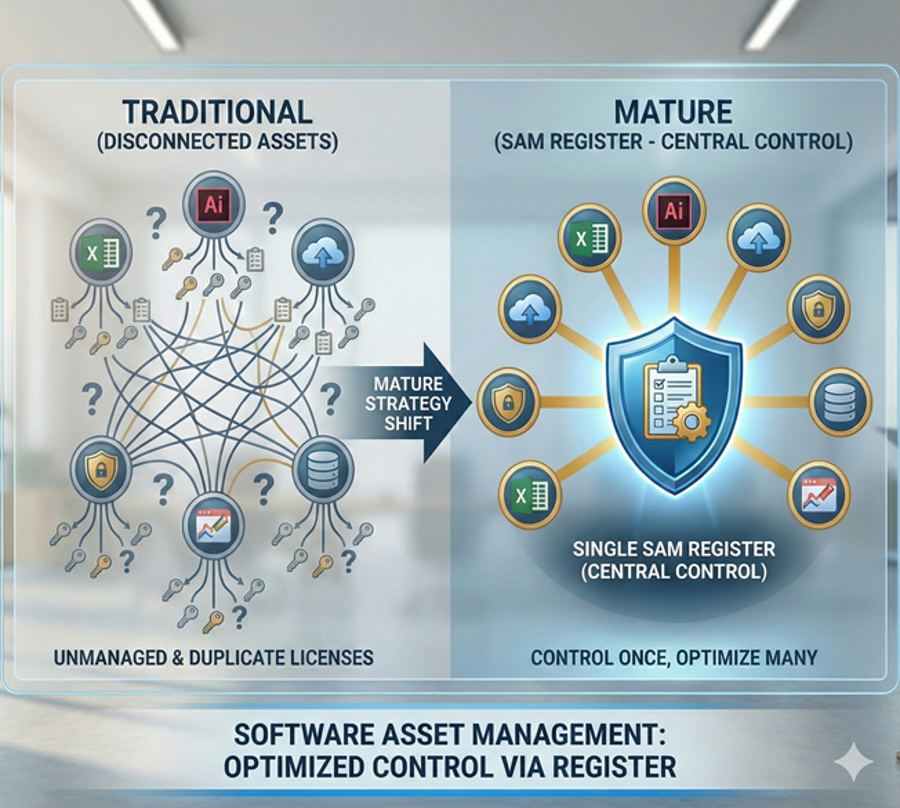
In today’s increasingly digital business environment, software is one of the most critical assets within any organisation. However, without proper control and oversight, unmanaged software can introduce significant financial, operational, and information security risks. Establishing a Software Asset Management (SAM) Register provides a structured and compliant approach to managing software throughout its lifecycle — from procurement to retirement — ensuring alignment with governance, risk, and information security objectives.
1. Context and Rationale
Modern organisations depend on a diverse portfolio of software applications for daily operations. These may include licensed business tools, open-source programs, and cloud-based services. Without a formal SAM process, the business risks losing visibility over what software is installed, who is using it, and whether it complies with licensing and security requirements. This lack of control exposes the organisation to potential license non-compliance fines, data breaches, and malware infections introduced through unapproved or pirated software.
From an information security perspective, unapproved software can bypass established security controls, operate without patch management, and create exploitable vulnerabilities. For example, applications downloaded outside of IT governance may contain malicious code or fail to receive critical updates. Under ISO/IEC 27001 (Information Security Management Systems), clauses A.8.1 (Asset Management) and A.12.6 (Technical Vulnerability Management) require that organisations identify and manage information assets, including software, to mitigate such risks.
2. Business Objectives
The primary objectives of implementing a SAM register are:
- Visibility and Control: Maintain a complete and accurate inventory of all software assets across the organisation.
- Compliance Assurance: Ensure that all installed software is properly licensed, authorised, and aligned with vendor agreements and regulatory obligations.
- Information Security: Prevent the installation and use of unverified or insecure software that could compromise systems or data.
- Cost Optimisation: Identify unused or redundant software to reduce unnecessary licensing and maintenance costs.
- Governance and Accountability: Establish a formal approval process for software requests, reviews, and renewals.
3. Roles and Responsibilities
The key roles and responsibilities:
- IT Management: Maintain and update the SAM register, oversee software deployment, and ensure compliance with licensing and security policies.
- Information Security Officer: Review new software for security risks, ensure adherence to security standards, and integrate findings into the organisation’s risk register.
- Department / Business Unit Managers: Approve software requests within their business areas and ensure staff use only authorised applications.
- End Users: Comply with the approved software list and report any unauthorised installations or updates.
4. Benefits and Justification
A robust SAM register supports the organisation’s governance, risk, and compliance (GRC) framework by creating transparency and control over software assets. It enables regular security reviews of new and existing applications, reducing the likelihood of vulnerabilities and data leakage. Financially, it helps optimise software spend through license reallocation and the elimination of redundant tools. Operationally, it improves productivity by standardising software and ensuring compatibility across systems.
Moreover, implementing a SAM register strengthens compliance with ISO 27001 information security requirements and ISO 9001 quality management principles, particularly regarding continuous improvement and control of operational processes. It also supports audit readiness by providing clear evidence of software ownership, approval, and review.
5. Conclusion
A Software Asset Management Register is not merely an administrative tool—it is a critical control mechanism for protecting information assets, reducing costs, and maintaining compliance. By implementing a centralised, reviewed, and approved software register, the organisation demonstrates due diligence in managing its digital ecosystem, aligning technology use with its broader security and governance commitments.