Escaping the Audit Trap: Why Your Business Needs a "Golden Record" for Compliance
Posted on 01 December 2025 07:24
For many South African organizations, the compliance landscape has shifted from a simple checklist to a complex web of obligations. A modern Information Officer or CISO is no longer just looking at one standard; they are juggling the Protection of Personal Information Act (POPIA), potentially the GDPR if they deal with Europe, King IV™ governance principles, and rigorous international standards like ISO 27001.
The default reaction for many businesses is to treat each of these as a separate project. You create a POPIA project, an ISO project, and a cyber-insurance checklist. The result is silos of compliance.
This siloed approach leads to "Audit Fatigue." Your IT team ends up answering the same questions three different times, in three different formats, for three different auditors. You might have one policy for "Data Privacy" to satisfy the Regulator and a separate, slightly different policy for "Information Security" to satisfy an ISO auditor. This isn't just inefficient; it creates operational risk. When policies overlap but don't align, gaps appear.
The Solution: The "Golden Control"
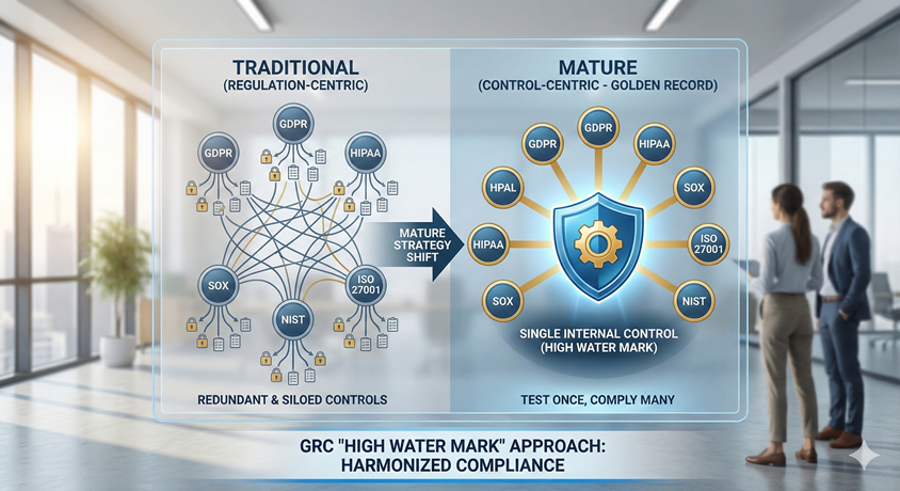
The most mature GRC (Governance, Risk, and Compliance) strategies move away from chasing regulations and start focusing on controls. The methodology is often called the "Golden Record" or the "High Water Mark" approach.
Instead of writing a control for every regulation, you write one internal control that satisfies the strictest requirement across all your obligations.
A Practical Example: The Password Dilemma
Imagine you are subject to three different requirements regarding user access:
- A Privacy Regulation: POPIA Section 19 requires "appropriate, reasonable technical measures" to prevent unlawful access [1].
- An Industry Standard: The Payment Card Industry Data Security Standard (PCI DSS) explicitly requires passwords to be changed every 90 days [2].
- A Cybersecurity Framework: ISO 27001 (Control A.5.17) requires strict management of authentication information [3].
If you treat these separately, you have three moving parts. In the Golden Control approach, you synthesize them into one internal standard:
“Passwords must be 12 characters, alphanumeric, and changed every 90 days.”
By implementing this single "Golden Control", you automatically satisfy the Privacy Regulation's demand for "reasonable measures," the PCI DSS specific timeframe, and the ISO framework simultaneously.
The Role of Technology
This is where spreadsheets fail. Managing a many-to-many relationship between hundreds of regulations and internal controls in Excel is a recipe for version-control disaster.
A specialized software tool, like Exponuity, transforms this theoretical mapping into a dynamic engine. It allows an organization to:
- Ingest the relevant laws and standards.
- Map them to a central repository of internal controls.
- Test Once, Report Many.

This is the ultimate efficiency gain. When you audit your "Golden Control" for passwords and gather the evidence (e.g., a screenshot of your Active Directory settings), the software automatically tags that evidence against POPIA, ISO 27001, and King IV. You effectively kill three birds with one stone.
Conclusion
Compliance shouldn't be about generating paperwork; it should be about generating trust. By consolidating your efforts into a unified framework, you reduce the burden on your team, cut the cost of external audits, and move from reactive checkbox-ticking to proactive risk management.
References:
- Protection of Personal Information Act 4 of 2013, Section 19 (Security measures on integrity and confidentiality of personal information).
- Payment Card Industry Data Security Standard (PCI DSS) v4.0, Requirement 8.3.
- ISO/IEC 27001:2022, Information security, cybersecurity and privacy protection — Annex A Control 5.17 (Authentication information).
- King IV Report on Corporate Governance™ for South Africa, 2016, Principle 12 (Technology and Information).