Beyond “Nice to Have”: Opportunity Management in ISO 9001:2026
Posted on 09 February 2026 08:35
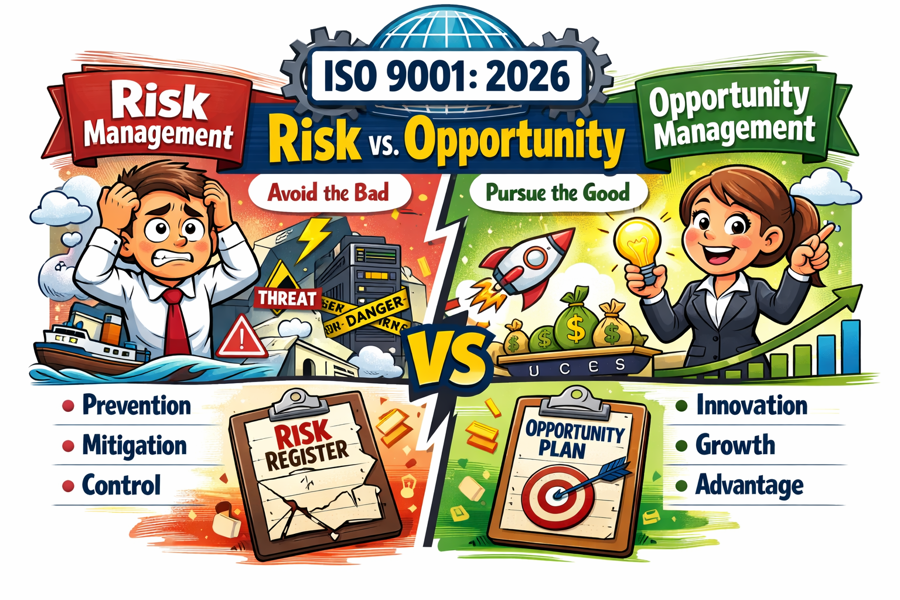
With the Draft International Standard (DIS) for ISO 9001:2026 already in circulation and publication expected in late 2026, quality professionals are beginning to assess what this revision will mean for their Quality Management Systems (QMS). While ISO 9001:2015 introduced risk-based thinking as a foundational concept, the upcoming revision places noticeably greater emphasis on how organisations identify, act on, and evaluate opportunities, not merely as the inverse of risk, but as a discipline in its own right.
For many organisations, opportunity management has historically received far less attention than risk management. Risks were documented, analysed, mitigated, and audited. Opportunities were often noted briefly in management review minutes or captured informally without consistent follow-through. The 2026 revision challenges that imbalance.
From Risk-Based Thinking to Opportunity-Based Thinking
ISO 9001:2015 addressed risks and opportunities together under Clause 6.1, requiring organisations to determine and address both in order to give assurance that the QMS can achieve its intended results. In practice, this often resulted in a risk-dominant interpretation. Opportunities were framed as “the absence of a risk” rather than as positive drivers of improved performance.
Draft material for ISO 9001:2026 signals a clearer conceptual distinction. While risk and opportunity remain linked by uncertainty, the intent of the revision is to ensure that organisations give structured attention to favourable conditions and potential improvements, not only to threats.
For quality professionals, this represents an important shift from a primarily defensive posture to a more balanced, improvement-oriented approach consistent with the principles of continual improvement and evidence-based decision-making.
Clarifying the Concepts
Risk
Risk continues to be defined as the effect of uncertainty on expected results, with an emphasis on prevention, mitigation, and control of undesired outcomes.
Opportunity
Opportunities relate to circumstances that can lead to enhanced performance, improved customer satisfaction, increased efficiency, or strategic advantage. The intent is not speculative innovation, but deliberate, managed improvement aligned with organisational context and objectives.
This distinction matters because it affects how organisations plan, resource, implement, and evaluate actions within their QMS.
What ISO 9001:2026 Is Likely to Expect
ISO standards remain non-prescriptive by design. They do not mandate specific tools, models, or templates. However, quality professionals should expect auditors to look for a systematic and repeatable approach to opportunity management, analogous in rigour (though not identical) to risk management.
Based on the DIS direction and ISO’s established principles, the following elements are likely to be scrutinised:
- Structured Identification of Opportunities
Organizations should be able to demonstrate that opportunities are identified intentionally, using inputs such as:
- analysis of internal and external context,
- customer feedback and performance data,
- technological developments,
- process performance and nonconformity trends.
The key audit question will be: How do you know these opportunities were identified systematically and not by chance?
- Evaluation and Prioritisation
While the standard does not prescribe scoring methods, organisations are expected to apply consistent criteria to decide which opportunities warrant action. Common approaches include assessing:
- potential benefit or value,
- feasibility or resource demand,
- alignment with strategic and quality objectives.
What matters is not the model chosen, but the consistency and rationale behind decisions.
- Planned Actions
As with risks, opportunities must be addressed through planned actions. Quality professionals should ensure that actions are:
- defined,
- assigned,
- resourced,
- integrated into existing processes rather than treated as side projects.
Opportunities that remain perpetually “identified but not acted upon” are unlikely to withstand audit scrutiny.
- Evaluation of Effectiveness
A significant area of focus in ISO 9001:2026 is expected to be evidence that actions taken actually contributed to improved outcomes. This does not necessarily require financial ROI calculations, but organisations should be able to demonstrate:
- what success looked like,
- how results were measured,
- whether the intended benefit was realised.
This aligns with ISO’s broader emphasis on performance evaluation and continual improvement.
Implications for QMS Design and Auditing
For quality professionals, the practical implication is that opportunity management can no longer be treated as an informal extension of risk registers or management review discussions. It needs:
- clear ownership,
- traceability from identification to outcome,
- records sufficient to support audit conclusions.
Internal audit programmes will also need to adapt, ensuring auditors are equipped to assess opportunity-related processes with the same objectivity applied to risks and controls.
Supporting Opportunity Management with QMS Tools
As opportunity management becomes more structured, many organisations are reassessing whether their existing QMS or GRC tools are adequate. Systems designed primarily for compliance tracking may struggle to provide traceability between opportunity identification, action planning, and outcome evaluation.
Tools that support:
- consistent assessment criteria,
- versioned decision records,
- integrated action tracking,
- and historical evidence for audits,
will be better positioned to support ISO 9001:2026 expectations, particularly in organisations with complex or rapidly changing contexts.
Conclusion
ISO 9001:2026 reinforces a message quality professionals have long understood: effective quality management is not only about preventing failure, but about enabling improvement. Opportunity management is no longer a peripheral concept, it is becoming a core mechanism through which organisations demonstrate maturity, adaptability, and strategic alignment of their QMS.
For quality professionals, the task now is to ensure that opportunity management is embedded with the same discipline, evidence, and intent that already characterise effective risk management, well before the first 2026 audits begin.